

(GLion Trades Wealth Strategy Note – August 2025)
Context: A World Looking for Real Assets
Gold has enjoyed a strong run in recent years, driven by geopolitics, central bank purchases, and investor anxiety. Yet beneath the surface, the more compelling long-term story lies not in precious metals, but in agricultural commodities. Unlike gold, which depends on sentiment and policy fear, agricultural assets are tied directly to consumption, trade, and survival.
Performance: Essential Demand, Structural Tightness
Agricultural commodities have quietly outperformed over multiple cycles. While gold delivered strong returns in 2025, U.S. wheat and soybeans also surged on tariff shifts and expanding Asian demand. Unlike metals, agricultural demand is non-discretionary: population growth, changing diets, and climate volatility ensure recurring pressure on supply chains.
Drivers: Consumption, Not Sentiment
Gold rallies when interest rates fall or geopolitical tension rises. Agricultural markets move for more concrete reasons:
- Population and protein demand in Asia continue to reshape global trade flows.
- Geopolitical shifts—such as tariffs on Canadian wheat—redirect demand to U.S. suppliers.
- Climate volatility creates episodic shortages, magnifying price swings and rewarding well-positioned owners.
The buyer of last resort is not a central bank… it is the global consumer.
Valuation: Transparent and Financeable
Gold has no yield, making it difficult to value. Agricultural commodities, by contrast, sit at the core of trade finance:
- Futures markets provide transparent benchmarks.
- Inventory can be financed, hedged, and leveraged through certified storage.
- Seasonal harvest cycles create recurring entry and exit points for disciplined capital.
Where gold is static, food commodities generate cash-flow opportunities.
Risks: Volatility and Policy Intervention
Agricultural markets are not without risk. Weather events, policy intervention, and shifting trade alliances can create volatility. However, unlike gold, these risks are tied to tangible supply and demand mechanics, not abstract sentiment. With disciplined risk management and storage infrastructure, they can be turned into advantages.
Crypto: A Distraction, Not a Substitute
Digital assets have captured attention as an alternative store of value. Yet while Bitcoin offers scarcity in code, it offers none of the practical utility that anchors food markets. Governments can regulate, reprice, or restrict crypto. They cannot ban hunger.
Where crypto appeals to speculation, agriculture appeals to survival. For long-horizon capital, one provides narrative volatility; the other provides permanent necessity.
Chart: CPI Weighting – Food vs Gold
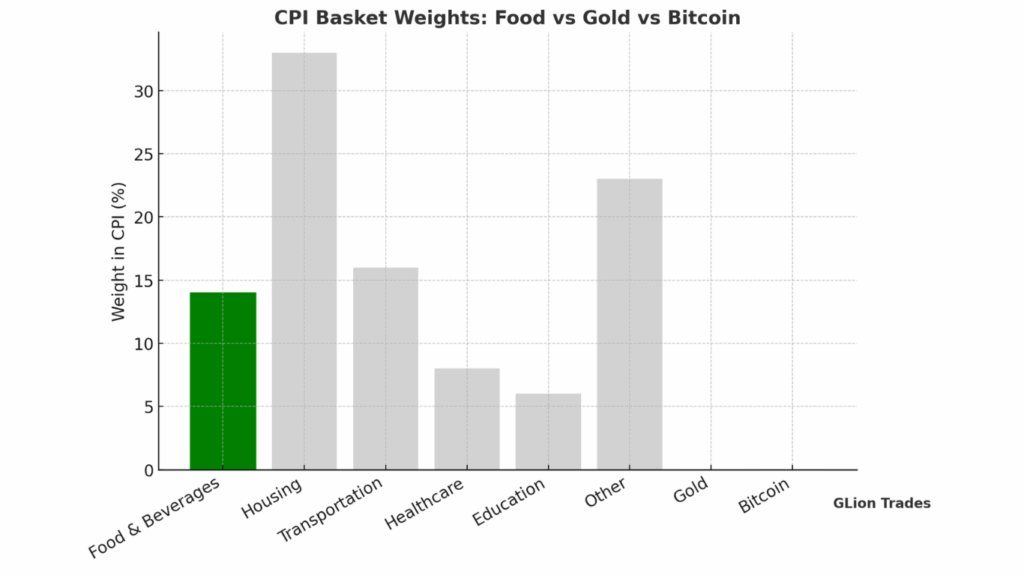
Caption: Food is inflation’s anchor. While gold and Bitcoin capture headlines, neither has any weight in the consumer basket that drives policy, prices, and portfolios. Food remains the stickiest and most unavoidable component of global inflation.
Strategic Role in Portfolios
For family offices and long-term allocators, the role of agricultural commodities is clear:
- Diversification: returns uncorrelated with equities and bonds.
- Inflation protection: food prices form the largest and most persistent component of CPI baskets.
- Cash-flow optionality: inventory ownership can be structured to deliver recurring realized gains.
“Gold preserves. Agriculture compounds.”
Conclusion
In a world seeking real assets, gold remains a store of value. But it is agricultural commodities—wheat, soybeans, flour, and beyond—that anchor value to the one market no government can print and no central bank can replace: food.
For capital that seeks both preservation and productive deployment, agriculture deserves a central role.